A dresspack — or dress pack — carries power, signal, air and process media from the robot base out to the tool, through six axes that never stop moving. It is also a common cause of unplanned downtime. A snagged hose, a chafed conductor or a collision with a fixture stops a cell just as fast as a failed drive, and it usually gets blamed on something else first.
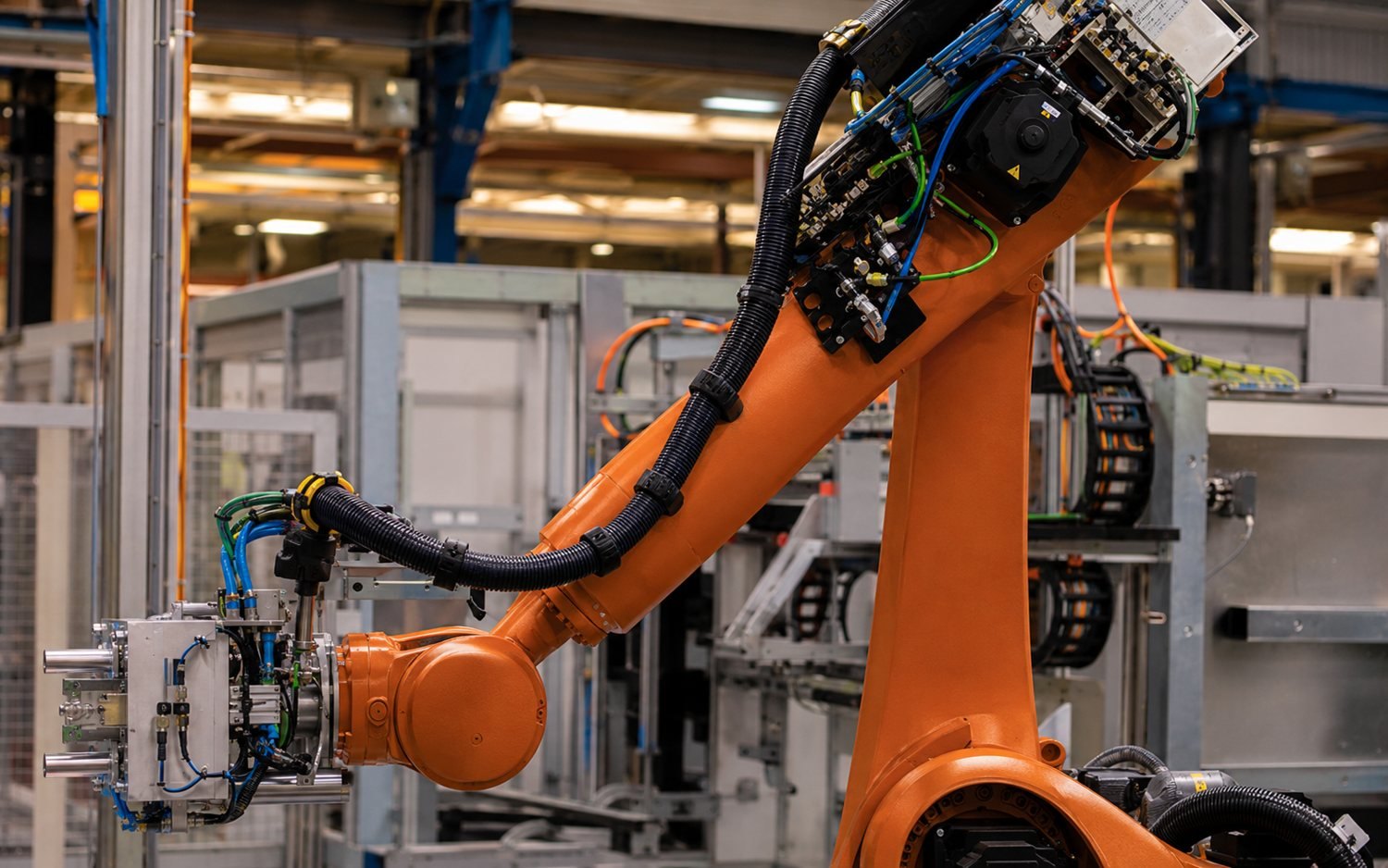
We supply, build and install packs for the work most lines actually do, and design from scratch when a standard kit does not fit.
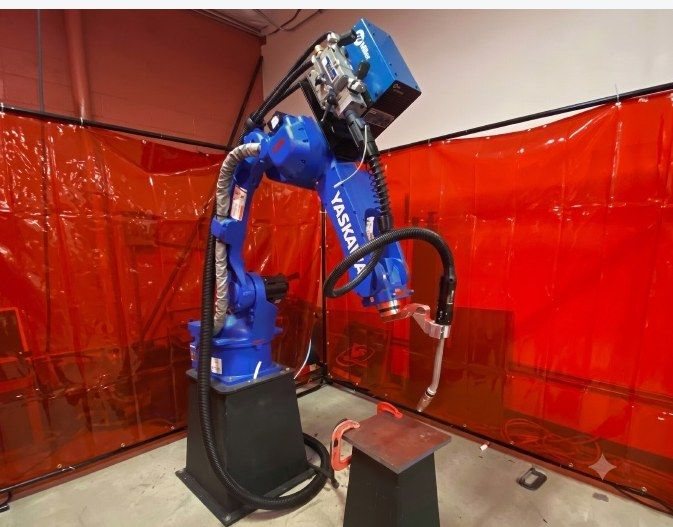
Torch cable, shielding-gas hose and wire-feed conduit bundled and strain-relieved for continuous-duty MIG/MAG and TIG cells.
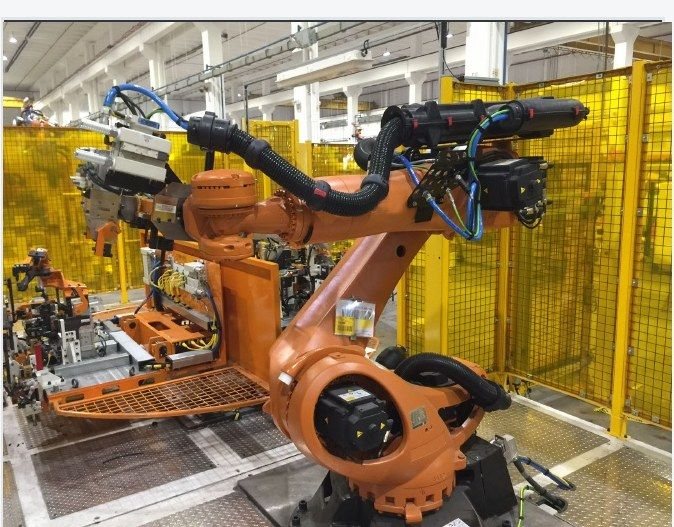
Heavy-gauge secondary current cable and water-cooling lines routed for high-current gun loads, built to survive constant flex cycles.
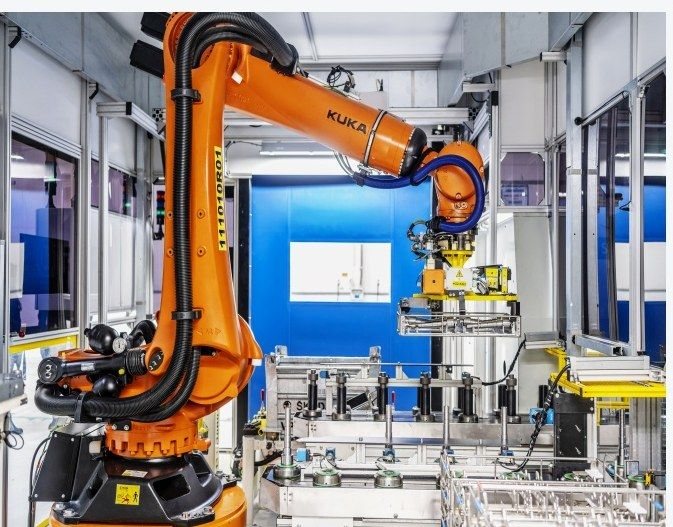
Multi-line air tubing and quick-couplings run out to the gripper. Sized so pressure still holds up at full reach.
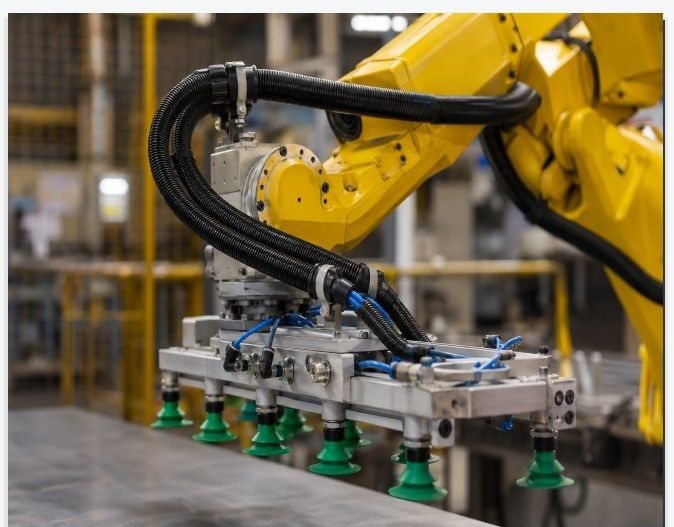
Vacuum hose bundles sized for suction-cup and end-of-arm tooling in pick-and-place and material-handling cells.
Most pack failures trace back to one of four things, and each of them is a specification decision.
Slack loops catch on fixtures, jigs and cell walls. We keep the pack close to the arm and check the trajectory for anything it can hit.
Axis 4 to 6 rotation twists the bundle past its rated angle. Correct component length and a pivot at the wrist relieve it.
Rubbing at clamps, brackets and casting edges wears the conduit through. Sleeving and correct clamp spacing prevent it.
Conductors and couplings break at the strain-relief point. Only robot-grade cable rated for millions of 3D flex cycles survives it.
A dresspack is an assembly. The retraction unit, conduit, brackets, clamps, couplings and the conductors inside all get specified together against the robot model, the reach and the duty cycle.
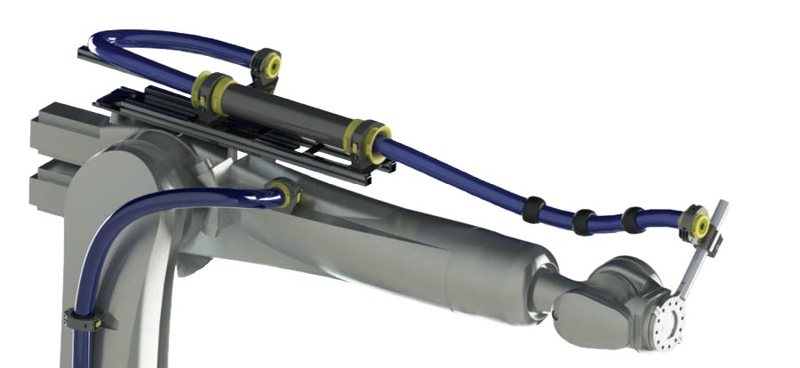
Compression-spring unit on the corrugated hose. Suits simple trajectories and short retraction lengths. Easy to service in the cell.
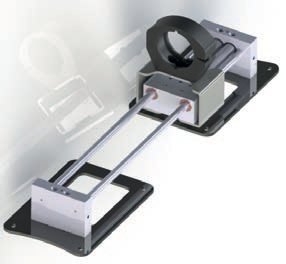
Compact housing on axis 3 carrying up to two packs. Mounts vertically, horizontally or overhead. Typical stroke 250 to 500 mm.
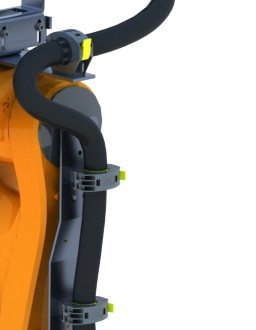
Bracket-and-clamp routing with no retraction element, for low-dynamic handling, machine tending and gantry applications.
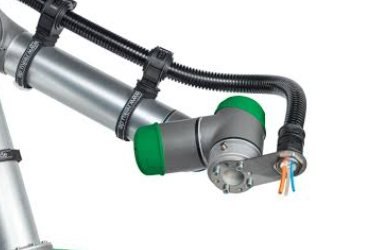
Strap-mounted flexible guides for collaborative and lightweight arms. No tools, no drilling, nothing modified on the robot.
Every dresspack has to give length out when the arm extends and take it back when the arm folds. How that happens is the single decision that determines whether the pack lasts five years or five months.
| System | What it is | Best for | Why you would pick it | What to watch |
|---|---|---|---|---|
| Spring retraction | Compression spring on the corrugated hose, usually at axis 3 | Short retraction lengths, simple trajectories, arc welding and general handling | Serviceable in the cell without removing the pack; lowest cost | Spring rate has to match the pack weight — too stiff and it loads the wrist, too soft and slack loops form |
| Linear / sliding | Sealed housing on axis 3, typical stroke 250–500 mm, carries one or two packs | Long reach, large working envelopes, spot welding and twin-media packs | Controlled retraction over a long stroke; mounts vertically, horizontally or overhead | Needs space alongside axis 3; the housing itself has to be kept clean in spatter-heavy cells |
| Fixed guided | Bracket-and-clamp routing with no retraction element | Low-dynamic handling, machine tending, gantry and shelf-mounted robots | Nothing to wear out, nothing to service | Only works where the trajectory does not demand length changes — get this wrong and the pack tears |
| Cobot / strap-mounted | Flexible guides on straps around the arm, no drilling | Collaborative and lightweight arms | Fits without modifying the robot; removable in minutes | Carries far less media, and straps need re-checking after the first weeks of running |
Most packs we are asked to repair were the right components fitted with the wrong retraction choice for the trajectory. Send us the cell and we will say which of the four it should be before anything is quoted.
Collision, torsion, abrasion and fatigue are the four mechanisms. Which one gets you first depends entirely on the process, and so does the fix.
| Application | What usually kills the pack | How it shows up first | What we change |
|---|---|---|---|
| Arc welding | Burn-through and conduit wear | Spatter pits the outer conduit near the torch; the wire-feed conduit wears from the inside and feed goes erratic before anything visibly fails | Spatter-resistant sleeving over the last section, a wire-feed conduit on its own replacement interval, and the pack routed out of the direct spatter cone |
| Spot welding | Secondary cable fatigue and water leaks | Cable breaks at the strain-relief point behind the gun; coolant weeps at a coupling long before it bursts | Heavy-gauge secondary cable rated for the flex cycle, couplings sized for the cooling circuit, and a torsion-relieving pivot at the wrist |
| Pneumatic handling | Coupling fatigue and torsion at axis 6 | Air pressure drops at full reach; tubing kinks near the gripper; fittings crack at the thread | Correct tubing bore for the run length, a rotating pivot bearing at axis 6, and slack sized for the real axis 4-6 rotation rather than the nominal one |
| Vacuum handling | Hose collapse and crush | Suction falls off intermittently with no visible damage — the hose is collapsing under bend or being crushed at a clamp | Larger nominal width than the bore alone suggests, wider clamp spacing, and guide rings where the bundle passes a casting edge |
| Palletising & long reach | Collision at the slack loop | A loop catches a fixture or cell wall once every few hundred cycles until something tears | Keep the pack tight to the arm, review the actual trajectory rather than the drawing, and use a linear retraction system over a long stroke |
| Cobots & lightweight arms | Strap slip and snagging | Guides creep along the arm over the first weeks and the bundle starts catching on the tool or the workpiece | Re-check and re-tension after the first fortnight of production, then fold it into the normal inspection round |
Corrugated hose for general cells, smooth tube where the cell gets wiped down or sees spatter and abrasive media. Other widths adapted on request.
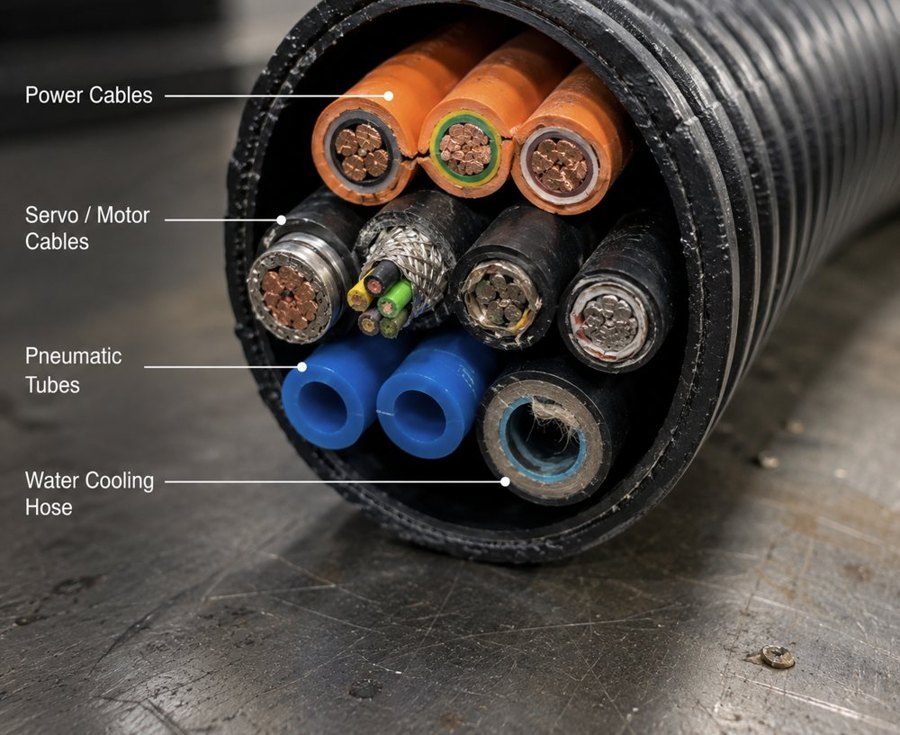
Size by the bundle, not by the largest line in it. A bundle that fills much more than roughly two-thirds of the conduit cross-section cannot move relative to itself, and a bundle that cannot move abrades and then fatigues — which is why an undersized pack usually fails at the strain relief rather than where it looks tight.
| NW | Typical use |
|---|---|
| NW 29 | Cobot and lightweight arms, signal-only packs |
| NW 36 | Pneumatic handling, small payload grippers |
| NW 48 | Arc welding, vacuum handling, general purpose |
| NW 56 | Combined power and media, medium payload |
| NW 70 | Spot welding, high current and water cooled |
| NW 95 | Heavy payload, twin packs and special machines |
A retractable reel keeps the pendant cable off the floor and out of the cell. It takes out the trip hazard, keeps the cable away from where it gets crushed, and heads off the usual cause of pendant connector failure. Several drum sizes and cable lengths, for all major robot controllers.
A catalogue pack for a common robot and application, supplied complete and ready to fit. Cheapest and quickest, provided the robot is standard and the cell has room.
A standard system with changed conduit length, altered bracket positions or a different media mix. Covers most retrofits and extended-reach robots.
Designed from the trajectory up for non-standard reach, unusual payloads, special machines or gantries. Includes bracket design and on-arm validation.
A well-built dresspack that is badly installed, or never looked at again, will still fail. We cover the whole cycle with our own service engineers, on your floor.
Before anything is quoted we work out what the pack has to survive.
Fitted by our own engineers, then tuned against the robot program.
Confirmation that the install matches spec and is fit for serial production.
A scheduled inspection plan usually costs less than paying for breakdown repairs, and it makes the spend predictable.
Costed up front, for measuring, handling and welding packs alike.
Make, model and variant, plus mounting position: floor, wall, ceiling or shelf.
What the tool does: welding, handling, gluing, measuring, cutting.
Every line the pack must carry: power, signal, bus, air, water, gas, vacuum.
Temperature, weld spatter, dust, coolant, wash-down or abrasive media.
A few shots of the arm and the cell. This alone answers most of our questions.
A dresspack — also written dress pack — is the routed bundle that carries power, signal, fieldbus, air, water, gas and vacuum from an industrial robot's base out to the tool at the end of the arm, together with the conduit, brackets, clamps and retraction system that let it survive six axes of continuous movement. It is a wear item, not a fitting: it is designed for a trajectory, and it fails when the trajectory changes or when it was designed for a different one.
None in practice — they are the same thing under different manufacturers' names. You will also see cable management system, cable package, robot hose package and energy chain used for the same assembly. Ask for whichever term your drawing uses; we will know what you mean.
Size it by the whole bundle, not by the largest single line. A bundle that fills much more than about two-thirds of the conduit's cross-section cannot move relative to itself, and a bundle that cannot move abrades and then fatigues. As a starting point: NW 29 for cobot and signal-only packs, NW 36 for pneumatic handling, NW 48 for arc welding and general purpose, NW 56 for combined power and media, NW 70 for spot welding with water cooling, NW 95 for heavy payload and twin packs.
Spring retraction suits short retraction lengths and simple trajectories, and is the easiest to service in the cell. Linear or sliding systems handle long reach and large working envelopes, with typical strokes of 250 to 500 mm. Fixed guided routing works only where the trajectory does not demand a length change at all — low-dynamic handling, machine tending, gantries. Cobots use strap-mounted flexible guides. Most packs we are asked to repair had the right components and the wrong retraction choice.
Most can be repaired. We diagnose first, quote a binding price before any work starts, and repairs carry a six-month warranty. A dresspack repair is typically diagnosed, quoted and returned inside a week. Where the pack was wrong for the application in the first place, we say so rather than rebuilding the same failure.
Yes, for all four and for other platforms on request, including older controller generations that are out of OEM support. We supply standard kits, adapted kits and fully custom builds, and we also install, tune the routing against the actual robot program, and inspect on a schedule.
It belongs in the same round as the rest of the cell: retraction function, clamp and bracket security, abrasion points, sleeving and conduit wear, and connector seating. The interval depends on duty cycle and process rather than calendar time — a three-shift spot-welding cell is not on the same clock as a single-shift palletiser. It is included in every tier of our maintenance contracts.
Robot make, model, variant and mounting position; what the tool does; every line the pack has to carry; the environment it works in — temperature, spatter, dust, coolant, wash-down; and a few photographs of the arm and the cell. The photographs alone answer most of our questions.
We diagnose it, quote a fixed price, repair, test, and send it back with a report. Usually inside the week. Ship it with the robot model, the application and a description of the fault.